
Petrarchism and Renaissance Women Poets
Sukanta Chaudhuri
“Let this suffice you, that it makes you write”
Gaspara Stampa, Rime #132
Extending the line from courtly love through the Tuscan dolce stil nuovo, Petrarchism redefined the position of women in European love poetry. Yet the more things changed, the more they remained the same. Petrarchism gave women a new inviolate space, an aura deterring the invasive advances of the male lover. This was attained at the cost of their near-total reification in sublimated rather than directly amatory or sexual terms. The woman of flesh and blood was robbed not only of the physicality but of the nuanced humanity of her being.
What happened when that poetry reached a female readership with its own sophisticated sensibility? Such a situation obtained from the days of Eleanor of Aquitaine if not earlier, long before Petrarca, but the Italian Renaissance afforded a wider and more varied milieu than ever before. Some wrote poems practising and extending Petrarchan convention. Others used its potential premises in strikingly different ways, questioning or even dismissing it.
In this post, I will look at two poets. Veronica Franco’s experience as a courtesan might have inspired an unusual clarity and directness in her view of amatory relations. Her 13th capitolo in terza rima opens: ‘Non più parole: ai fatti, in campo, al’armi’ [‘No more words! To deeds, to the battlefield, to arms!’]
Or mi si para il mio letto davante,
ov’in grembo t’accolsi, ...
per campo eleggi, ...
accomodato al tristo officio porta,
ferro acuto e da man ch’abbia ardimento.
Here before me now stands the bed
where I took you in my arms ...
choose this as a battleground ...
carry yourself as prepared for your dismal task,
bring with daring hand a piercing blade.
This lusty sensuality is matched by an ebullient cynicism about the fallout of amatory sentiment and the relationships based upon it:
Ché se libere in ciò fosser mie cure,
tal odierei, ch’adoro; e tal, ch’io sdegno,
con voglie seguirei salde e mature.  (Terza rime 8)
For if my feelings were free in this affair,
I would despise the man I adore,
and with steady, mature desire, I’d pursue the one I scorn.
Here speaks a female John Donne a hundred years before the latter, with the clear-eyed perception of her sex. But this is validated through a remarkable dialogism. The collection is actually the work of several authors. The poems fall into pairs, a contrary (usually male) voice resoundingly countered by Franco. The first four poems are the most pointed in this respect. In the first, Franco’s paramour Marco Veniero addresses her in abjectly Petrarchan terms:
La gran bellezza a voi data si sopra
spender in morte di chi v’ama e in doglia,
qual potete peggior far di quest’opra? (Terza rime 1)
To use the great beauty given you by heaven
for the death and grief of a man who loves you–
what deed worse than this could you commit?
Her reply is forthright enough: he must prove his love in ‘deeds’ rather than compliments. The nature of the ‘deeds’ is amply clear: they will prove her to be ‘dearer still to Venus’ than to Phoebus, the god of poetry.
Laura is writing back to Petrarca with a vengeance. But Franco can unburden herself in Petrarchan terms too, as in a series of tropes and conceits in the third capitolo, to an unidentified warrior. He had once offered her love and been rejected, as she was then in love with another. (Again the mismatch: A loves B who loves C…) But if now she has pity on him, he will happily comply, he responds in poem 4.
Franco is rewriting the Petrarch-Laura paradigm in robust real-life situations involving change, compromise and sensuality. Her engagement with Petrarchism is, we may say, external: it does not shape her relations with men but helps to define them, by conformity or contrast as the case may be.
It is different with Gaspara Stampa. She is trapped in a Petrarchan relationship with Collaltino di Collalto, with the gender roles reversed. Her lover, like Franco’s, has gone to the wars; but unlike Franco’s, he does not respond to her messages. She can decribe her state of mind in terms recalling Franco’s mosaic of love and hate:
Odio chi m’ama, ed amo chi mi sprezza; ...
e cosi stranio cibo ho alma avezza. (Rime #43)
I hate the one who loves, and love him who scorns me. ...
Thus does my soul long for such bizarre food!
But for Stampa, this is not one link in a chain of changing relations: it is a permanent state of infatuation for one who is indifferent to her. It allows her to plot her love against Petrarchan material. She repeats familiar Petrarchan tropes like ‘agghiacci e sudi’ [‘I both freeze and sweat’: Rime #243]. In fact, her first sight of her beloved, on Christmas day, pointedly recalls Petrarca’s first glimpse of Laura at Easter.
The crucial difference is that whereas Laura never granted her favours to Petrarca in the first place, Stampa is neglected, and she fears abandoned, by a man who once loved her and whom she loves still. The early accounts of her love are Petrarchan with an upbeat subtext that Petrarch himself does not afford:
...un viso più che ‘l sol lucente e chiaro,
ove bellezza e grazia Amor riserra ...
fûr le catene, che già mi legâro,
e mi fan dolce ed onorata guerra. (Rime #6)
A face more clear and radiant than the sun,
Where grace and beauty are by Love bestowed, ...
Such are the chains that Love on me does load;
And makes sweet and honored war on me.
This is quintessentially Petrarchan in idiom. Even the ‘anguish’ of her love testifies to a relationship with her exalted and negligent lover:
Quant’ei tutt’altri cavalieri eccede ...
tanto è vinto da me, da la mia fede.
Miracol fuor d’amor mai non udito!
Dolor, che chi nol prova non lo crede!
Lassa, ch’io sola vinco ‘linfinito!  (Rime #91)
As much as he excels all other knights, ...
Thus much he’s conquered by the faith I have.
Miracle never heard of except in love!
Pain that those who have not suffered it, cannot believe.
Alas, I alone conquer the infinite!
This anguish is not a construct of the mind but the outcome of a real human relationship that begins positively. When spring comes, the poet rejoices that ‘her springtime’ (‘la mia primavera’) Collaltino is with her (Sonnet 107). But there is premonition in the closing lines of the sonnet: ‘oh pur non cangi il bel tempo in orrore.’ [‘Oh may this lovely time not turn to horror.’]
But it does. The wine darkens. The fine balance of suspense and fulfilment is shattered.
Io son da l'aspettar omai sì stanca,
sì vinta dal dolor e dal disio,
per la sì poca fede e molto oblio
di chi del suo tornar, lassa, mi manca ... (Rime #47)
By now I am so weary of this waiting,
So vanquished by desire and grief
For him of little faith and much forgetfulness
Of whose return, alas, I am deprived.
The quintessentially Petrarchan trope of fire and ice, simultaneously burning and freezing, is fragmented between the two parties, resulting in an opposition or contrast rather than a balance:
... perch’io son di foco e voi di ghiaccio,
voi sète in libertade ed io ‘n catena,
i’ son di stanca e voi di franca lena,
voi vivete contento ed io mi sfaccio. (Rime #41)
because I am made of fire and you are made of ice,
you are free and I am in chains,
I am tired and you are full of vigour,
you live happily and I in disgrace.
She escapes to the woods like Petrarca, but cannot withdraw like him into a life lived in nature. Rather, she sees her sojourn as a time of waiting till she can return to her lord, despite her premonitions to the contrary. She tells the forest birds to carry her plaintive message to him, and the woods and wild creatures to tell him that they do not please but bore her (Rime #244).
A crucial factor comes into play here. It is generally accepted that Gaspara’s sister Cassandra arranged the poems in chronological order for the first edition of 1554, published soon after Gaspara’s death. If that is so, her relationship with Collaltino was troubled and equivocal from the start, discord alternating with harmony, the frustration itself sometimes an enriching Petrarchan aspiration for the elusive and unattainable, sometimes a plain human despair. The graph of Gaspara’s love for Collaltino does not follow a clear curve but goes endlessly up and down.
Such is the course of what we can fairly see as a Petrarchan relationship worked out in real life. It concludes unhappily because the woman is not content to remain a reified object of adoration: she wants to offer love on her own terms. She thereby opens up the yawning gap in the Petrarchan concept of love: it is sustained only as long as it remains unfulfilled. (I have elsewhere called this the Petrarch Trap for Lovers.) A single discordant outcry can shatter the fiction:
... giovane e donna e fuor d'ogni ragione,
massime essendo qui senza 'l mio core ... (Rime #142)
[I’m] young, a woman, beyond all rule and reason,
And what is most, I’m here without my heart.
These are astonishing lines for a Petrarchan poem. It needed a special feminine take on Petrarchan love to bring this desolation within its compass, effecting its complete deconstruction.
One thing and one alone sustains Gaspara: her anguish has activated her poetry, her pain (pena) her pen (penna) (Rime #8). When she complains to the god of love, he answers in a single sentence: ‘questo ti basti, e questo fa’ che scriva’ [‘Let this suffice you, that it makes you write’: Rime #132] Something very new is happening here. Laura was Petrarca’s muse, as Beatrice was Dante’s. But Gaspara’s muse is not Collaltino; it is she herself. Her being destabilized by love, she seeks its still centre in poetry, outside all human relationships yet fed by them as its theme.
The European Renaissance was perhaps the first age anywhere with a small but sufficient number of like-minded women to sustain a literary community of their own. It is testified by Veronica Gambara’s sonnets to Vittoria Colonna, or Lucia Bertani’s to both, invoking Sappho and Corinna. Stampa has a sonnet to the distinguished Giovanna d’Aragona (and of course to a far greater number of men). But much more importantly and perhaps uniquely, the vulnerability of her love leads her to construct an inviolable sanctum of poetry, not to carry her beyond her tempestuous life but to recreate it in a new light.
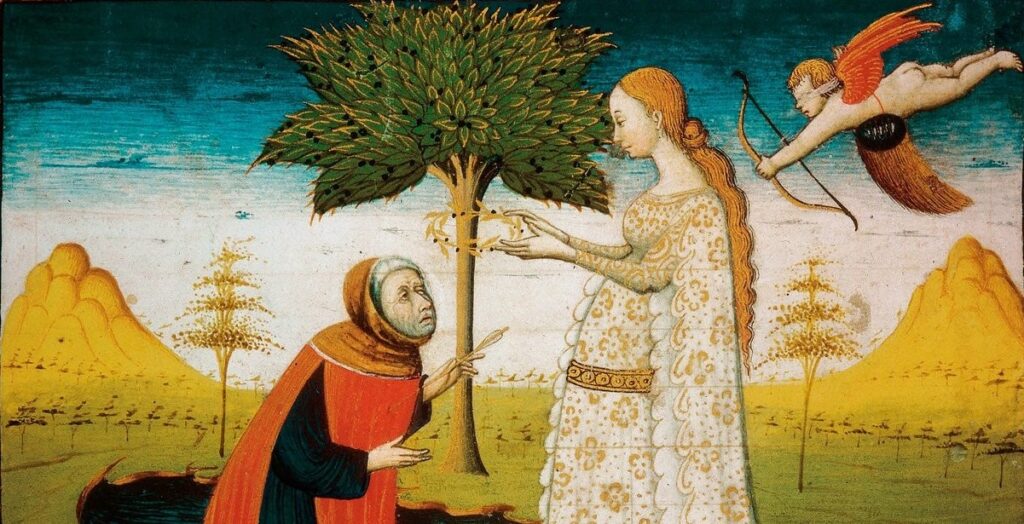
The featured image of Petrarch and Laura is from the Wikimedia Commons
_______________________________
FURTHER READING
In the true spirit of a blog post, I have not given detailed references, but every poem carries its standard number.
For Veronica Franco, I have taken both the original text and translations from her Poems and Selected Letters, ed. & tr. Ann Rosalind Jones and Margaret F. Rosenthal (Chicago, 1998).
For Gaspara Stampa’s Rime, I have followed what is still the standard edition, by Abdelkader Salza (Bari, 1913). (The volume includes Franco as well.)
For translations, I have used eclectically, and often modified, the versions in Women Writers of the Renaissance and Reformation, ed. Katharina M. Wilson (Athens, Ga., 1987); Women Poets of the Italian Renaissance: Courtly Ladies and Courtesans, ed. & tr. Laura Anna Stortoni & Mary Prentice Lillie (New York, 1997); and rarely, the online Biblioteca Italiana. However, the last-named appears to rely on machine translations, and its versions range from the clumsy to the unintelligible.