
Jean de Thévenot and François de La Boullaye Le Gouz
Niranjan Goswami
However it be, if one considers that number of spacious Temples, full of Pillars and Pilasters, and so many thousands of Figures, all cut out of a natural Rock it may be truly said, that they are Works surpassing humane force […]
(The Travels of Monsieur de Thevenot, 1687, 76)
Two decades after the first visit of Jean-Baptiste Tavernier and six years after François Bernier, a traveller named Jean de Thévenot arrived in Surat in 1666 during Aurangzeb’s reign. A year later, his compatriot, the Hugenot jeweller Jean-Baptiste Chardin would arrive in India too, followed by further visits between 1677 and 1680, but it is Chardin’s travels in Persia that would become famous by the eponymous work published in English as Travels in Persia (London, 1720; the original work being Journal de Voyages… de Chardin en Perse et aux Indes Orientales, Amsterdam, 1686). Tavernier visited India six times, meeting Emperors Shahjahan and Aurangzeb, while Bernier worked in the Mughal court as a doctor to Dara Shikoh and later to Aurangzeb, making India his home for twelve years. Unlike other seventeenth century French travellers, however, Jean de Thévenot and François de La-Boullaye Le-Gouz came to India with a deep-seated desire of recording ethnological, anthropological details, flora and fauna, apart from the conventional geographical and commercial observations. In this they were continuing the Enlightenment project of classifying knowledge into useful, functional, though at times hazily comprehended categories of data for possible future use.
Compared to his other French counterparts, Thévenot travelled through the Levant and India for the shortest period, visiting India only for 13 months. His travels are recorded in The Travels of Monsieur de Thevenot. In Three Parts of which the third part contains the Relation of Indostan, the New Moguls and of other Peoples and Countries of the INDIES now made English (London: 1687). He met Tavernier in Isfahan, after which, having visited the ruins of Persepolis, he came to Surat by ship from Basra, exploring Ahmedabad, Cambay, Aurangabad and the Ellora Caves. He was, in fact, the first European to visit the Ellora Caves and his description of them may be called a mix of strangeness, awe and incomprehension:
However it be, if one considers that number of spacious Temples, full of Pillars and Pilasters, and so many thousands of Figures, all cut out of a natural Rock it may be truly said, that they are Works surpassing humane force; and that at least, (in the Age wherein they have been made,) the Men have not been altogether barbarous, though the Architecture and Sculpture be not so delicate as with us. (76)1
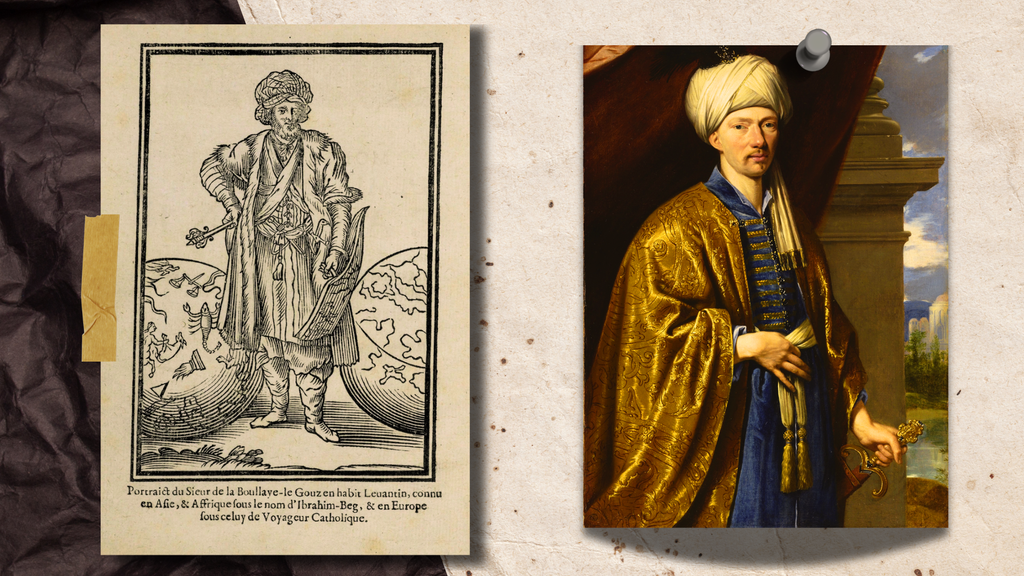
Rather than visiting the Mughal court, Thévenot proceeded to Golconda and Masulipatam, describing many cities of India and ordinary lives of the people. During his return journey he passed the summer of 1667 at Isfahan, disabled by an accidental pistol shot. Attempting to reach Tabriz, he died on the way at Miyanaon in November 1667 at the age of thirty-four. Thévenot was a botanist, an acute observer of flora and fauna, of people and their customs and even adopted the Persian fashion of dress as is apparent from his portrait. In this he was similar to his compatriot François de La Boullaye-Le-Gouz who travelled in India from 1646 to 1649 and again in the mid-1660s, publishing Les Voyages et Observations du Sieur de la Boullaye le-Gouz (1653).
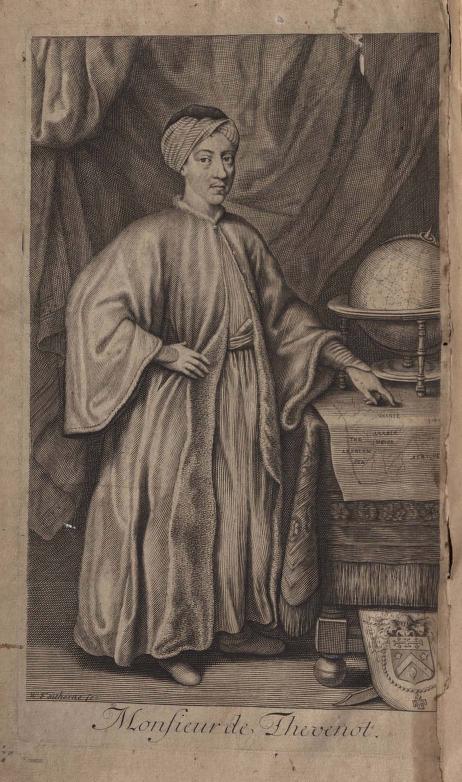
The interests of French travellers in India in the seventeenth century were centred around trade, diplomacy or missionary activities. However, French travellers like Thévenot had an acute interest in the people of the “orient” from an ethnological point of view as a part of the Enlightenment project. Crossing the Levant, that is Turkey, Persia, some countries of the Middle East and Central Asia (if they travelled by land), European travellers would come to Mughal India looking upon it as a natural extension of the Persianate culture, with Thévenot and La Boullaye continuing to adopt the Persian style of dressing in Mughal India. La Boullaye was an exception in that he also changed his name to Ibrahim Begh, wearing Persian clothes even after his return to Europe, thus being considered a kind of exotic figure.
Thévenot’s text reveals his interest in the Indian caste system like other Europeans but he bases his description on observation rather than hearsay:
The eighty four Tribes observe among themselves an Order of Subordination. The Banians yield to the Courmis, the Courmis to the Rajpoutes or Catrys, and these (as all the rest do) to the Bramens; and so the Bramens are the chief and most dignified of the Gentiles. And therefore it is, that a Bramen would think himself prophaned, if he had eaten with a Gentile of another Caste than his own, though those of all other Castes may eat in his House. And so it is with the other Tribes in relation to their inferiours.
The Bramens who are properly the Brahmanes or Sages of the Ancient Indians, and the Gymnosophists of Porphyrius, are the Priests and Doctors of the Heathens in India. Besides Theologie (which they profess) they understand Astrologie, Arithmetick and Medicine; but they who are actually Physicians, pay yearly a certain Tribute to their Caste because Physick ought not to be their Profession. All these Gentiles have a respect for the Bramens; and they believe them in all things, because they have been always told that God sent the four Bets to them, which are the Books of their Religion, and that they are the keepers of them. (64)
Thévenot knows that all eighty-four castes are under one of the four major castes in India viz. Brahmin (Bramens), Baishya (Banians), Kshatriya (Catrys) and Shudra (Courmis). That this hierarchy is manifested through the social customs of eating or the prohibition of doing so is a new ethno-cultural feature that he serves the Western reader. We will see that La Boullaye would also point this feature out as noteworthy. Thévenot is also quick to identify the concept of rebirth with the Pythagorean theory while connecting it curiously with Indian food habits:
The Bramens believe the Metempsychosis or the Transmigration of Souls into New Bodies, more or less noble, according to the merit of their Actions, which they have done in their Life-time. And many of the other Castes follow that Opinion of Pythagoras; They believe that every Soul must thus make many Transmigrations; but they determine not the number; and therefore there are some who kill no Beast, and never kindle Fire nor light Candle, for fear some Butterflie will burn itself thereat: It being possible (say they) that the Soul of a Butterflie may have lodged in the Body of a Man, and they have the same Sentiment of other Animals. In prospect of saving living Creatures, they often sollicite the Mogul Governours, to forbid Fishing on certain Festival days (65)
From the point of view of comparative ethnography, Western writers were desirous of comparing with ancient Greek culture the culture of Asia and were intrigued at the same time by unexpected parallels in culture, customs and certain philosophical concepts between ancient Greece and that of Persia and India. Tavernier also identifies the Indian yogis with the gymnosophists mentioned by the Greeks. Pythagoras’s theory of the transmigration of the soul exemplified in the tale of the Pythagorean cock finds amplification in Thévenot’s image of the butterfly.
In Akbar’s time Orissa was divided into five Sarkars and incorporated into Bengal. Referring to the Sarkar Jalesar, Thévenot makes revealing comments about the composite culture of Orissa and Bengal and its people, beginning with a curious event involving a fakir:
The Province of Oulesser, which we call Bengala, and which the Idolaters name Jagannat; because of the famous Idol of the Pagod of Jagannat which is there, is inhabited by Gentiles, no less fantastical in point of Religion, than those of Halabas [Allahabad]; and this one instance may serve for a proof of it. A Faquir intending to invent some new spell of Devotion that was never seen before, and which might cost him a great deal of pains, resolved to measure with his Body the whole extent of the Moguls Empire, from Bengala as far as Caboul, which are the limits of it from South East to North West. The pretext he had of so doing, was, that once in his life he might be present at the feast of Houly, which I have already described, and he had a kind of novices to wait upon him and serve him. (67)
The interest of a Catholic traveller in the rituals of a people belonging to a different religion is evident here; in this case the prostration pilgrimage or dandavat parikrama of the Hindus and the Buddhists. Thévenot gives a short description of the bathing rituals at Allahabad (Prayag) or ‘Halabas’. Interestingly, Thévenot also describes the celebration of the Holi festival in Kabul. An ideational map of India from Bengal to Kabul was still vivid in the writings of these seventeenth-century travellers who found a continuity in the Persian, Turkish and Mughal empires and the freedom of pursuing one’s religion in India, whether Hindu, Muslim, Parsi, Buddhist or any other as categorically spelt out by both Thévenot and La Boullaye.
Thévenot’s keen observation of not just people and regional customs but also of the natural habitat is evident from his portrayal of a bird from Bengal which he describes with the passion of an ornithologist:
The Ganges is full of pleasant Islands, covered with lovely Indian Trees; and for five days sailing on that River, Passengers are delighted with the beauty of them. In these Isles and some other Places of Bengala, there is a bird called Meina, which is much esteemed; it is of the colour of a Black-bird, and almost as big as a Raven, having just such another Beak but that it is yellow and red; on each side of the neck, it hath a yellow streak which covers the whole Cheek till below the eye; and its feet are yellow; they teach it to speak like a Starling, and it hath the tone and voice much like; but besides its ordinary Voice, it hath a strong deep Tone which seems to come from a distance; it imitates the neighing of a Horse exactly, and feeds on dryed Pease which it breaks. I have seen some of them upon the Road from Masulipatam to Bagnagar. (68)
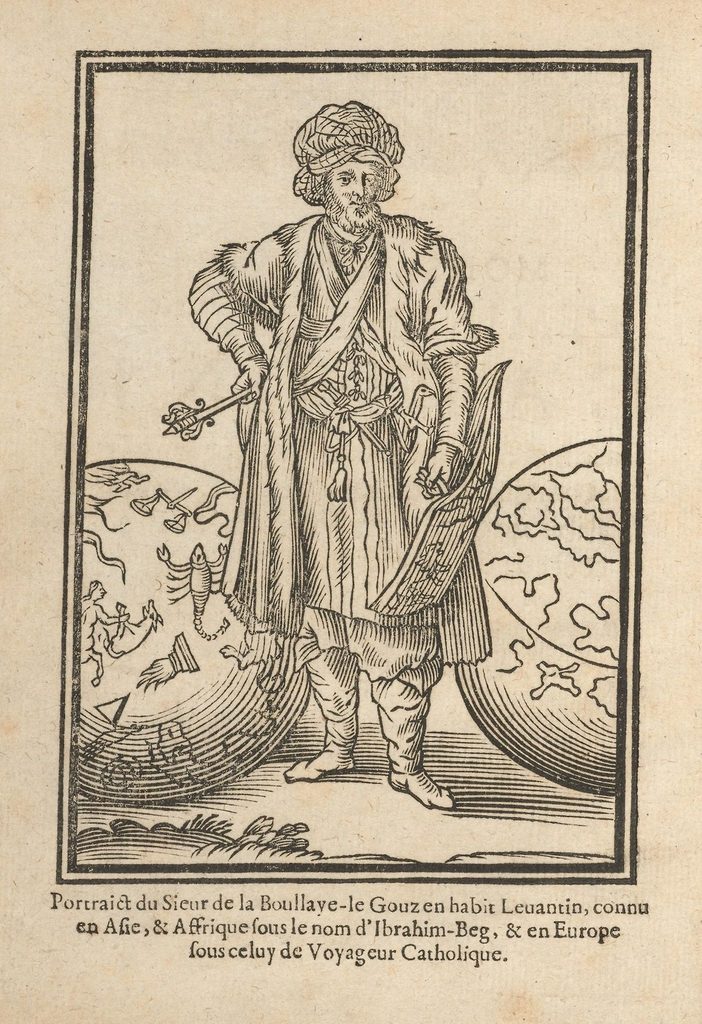
Like Thévenot, La Boullaye also displays an interest in the caste system of India. However, he finds 125 castes in India as opposed to 84 that Thévenot had identified. He writes:
Brameens are the first among the castes that we call Bracmanes in a corrupted way. They are the only ones who can make sacrifices [to gods] and have many similarities with the Levites of the Old Testament. The second are the Bagnians and after them the Kattries, Rajpouts, Sharaf, Dalsis, and other Artisans according to their order and nobility of professions; one Tribe never marries into another tribe so that a Brameen cannot marry a girl other than a Brameen, nor can a Bagnian marry into any caste than Bagnian and so on; and from this has arisen the diversity of languages among them. The Bramen, Breamen or Breameni cannot drink water or eat bread from any of the other 124 Tribes who are below him and the others can all drink water from a Brameen or eat the food cooked in his house. The Bagnian, who is from the second Tribe cannot drink water from any Tribe except from the Brameen, the same way that others can drink and eat from those who are superior to those and not from those who are inferior. (146)
Whereas La Boullaye’s observations regarding caste prohibitions about food are more or less accurate, he goes astray in thinking that different castes speak in different languages. The nomenclature of castes as “Tribes” by Europeans was a common mistake due to their unfamiliarity with the idea of caste before arriving in India. Apropos ethnological observations, La Boullaye is the first to call Indians “Indous” unlike other travellers who call the Hindus “Gentiles” and the Muslims “Musulmans”. La Boullaye, of course, observes the variety of ethnic groups in India, particularly noting the Parsis, the Rajputs and others.
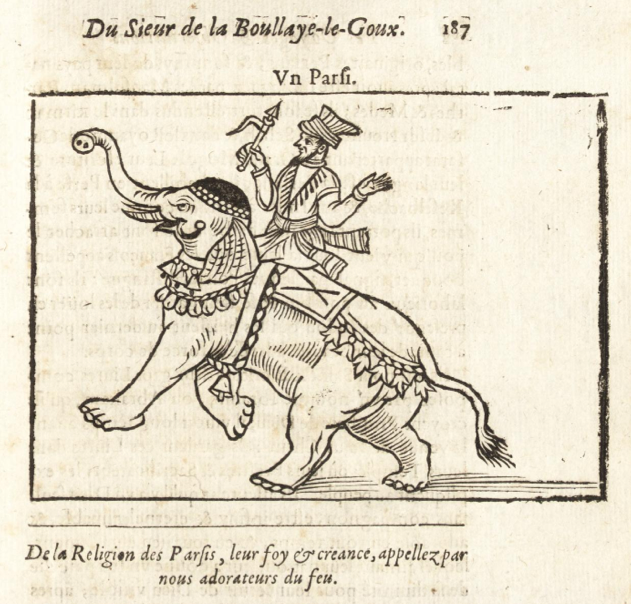
The Ottomans call a sect of Pagans whom we know as worshippers of fire. The Persians know them as Atech peres [Ateshparast in Persian means fire worshipper] and the Indous know them as Parsis, a name by which they call themselves. They are white, generous and very accommodating, Persian by origin, who fled their country when it was defeated by the Musulmans, Parthians and Medeans. They are heavily spread across the Kirman and Iesdr provinces of the Shah and in the realm of Gujerat belonging to the Great Mogol. Their language and writing are Persian. In Persia they dress like the Keselbach [Qizilbash or red head Shia Turkomen] and in India like the Indou and their women. They wear a great beard and pluck the hair that grows under the head, which the French call bouquet and it is a mark of their distinction. They are industrious and one must be careful in praising them because the Indous hate them much because of their beauty, skill and strength. (188)
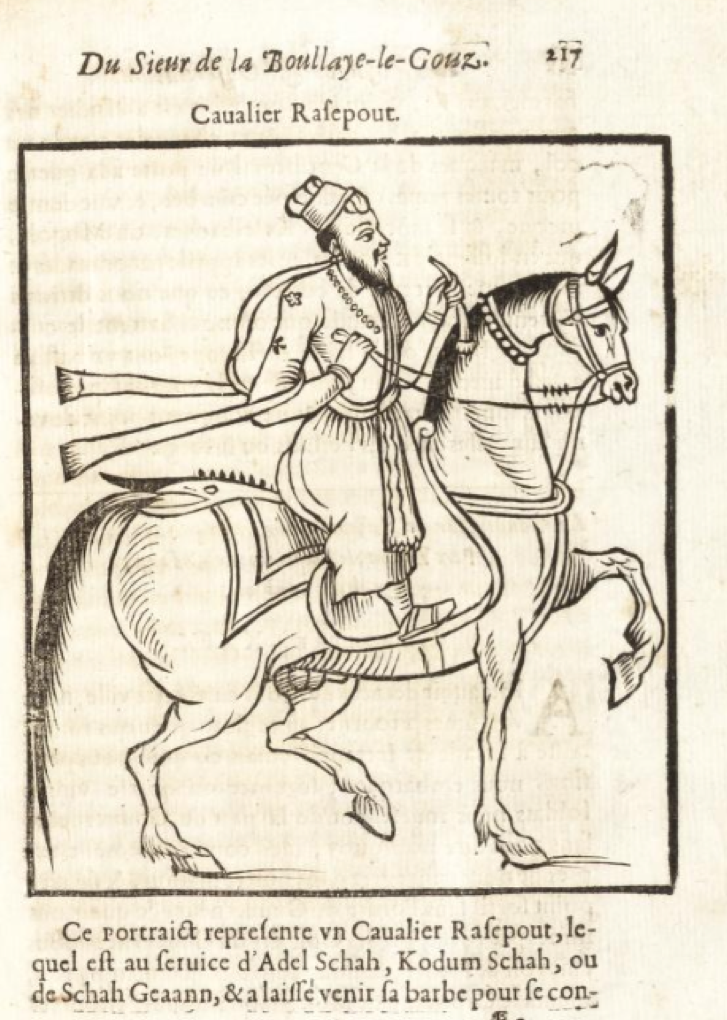
Similar detailed observations may be seen in the description of a Rajput warrior. The cavalryman wears a beard which is explained by La Boullaye as:
[A]n attempt to satisfy his Muslim master who was Adel Shah, Kodum Shah or Shah Geann [Shahjahan]. His dress is Indian, he has pearls on his ears, a rosary hanging from his neck, which is a mark of nobility. He carries in war for all weapons only a curved sword and a half pike, and mocks the Keselbaches, or Moguls, who carry Quivers and calls them by bravado and mockery cotton-beaters, which we would say wool-beaters, because those who beat cotton in India or wool in Europe, have a curved baton which resembles a bow. These Rajepouts are very valiant, and do not fear to come to war with the Persians or Iusbegs. (218)
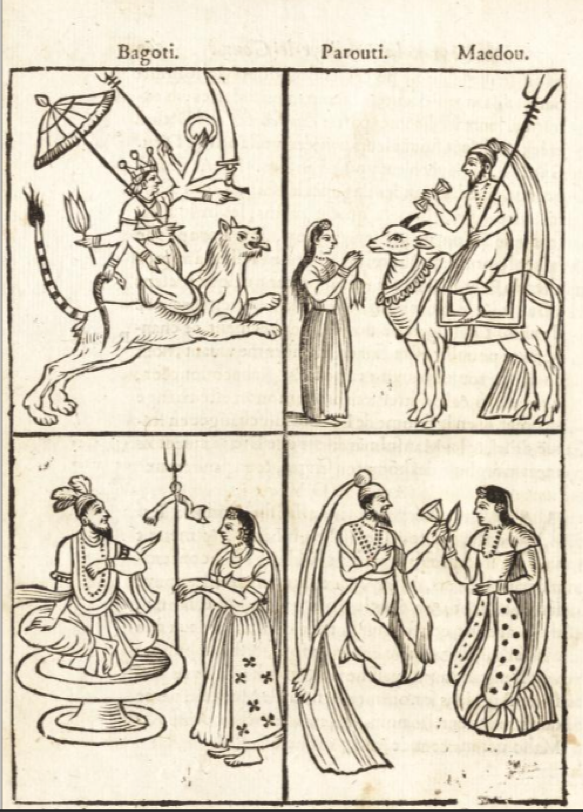
In a novel departure from other travellers La Boullaye shows a marked interest in Hindu theogony: he may be forgiven for a few mistakes (for example, he thinks that Ganesha is Ram’s porter), but his illustrations enliven a narration that is a heady mix of mythological tales and references to the pantheon of the Hindu gods. La Boullaye also adds the stories of Krishna and the Gopinis as well as the miracle of the subjugation of Kaliya, the serpent. Indian mythology, with its powerful symbolic imagery, would appear to a westerner as replete with objects of curiosity, at best of anthropological research. The emotions, the devotion and religious sentiments would remain undeciphered.
In this illustration La Boullaye depicts clockwise Hanuman, Ram and Sita, Mahadev, Ganesh and Ram and Laxman. (162–3) The descriptive title of the chapter is as follows:
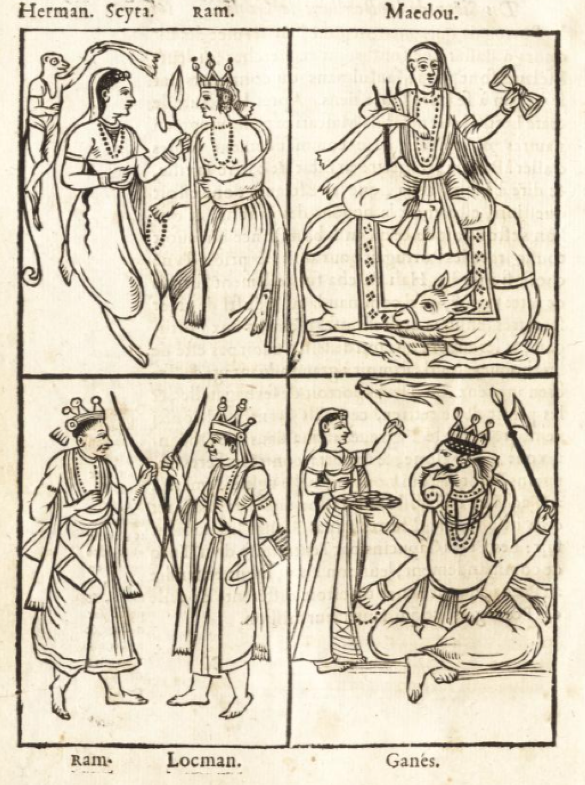
The idols of the Indou, what he believes about the god Ram and his wife Schita and his brother Locman, his servant Herman, about his doorman Ganes and Maedou, the father of Ganes
La Boullaye gives as much detailed an explanation of the ‘Indou’ pantheon as possible, though it is clear that he is in uncharted territory. The depiction of Hanuman or Herman is far from realistic. In the following illustration, the eight-handed Bhagabati or Bagoti defies all rules of the western science of anatomy while Parouti (Parvati) and Maedou (Mahadev) appear Persianate in their dress with Maedou sporting a beard and cap with an ornate tassel (dreadlock transformed). However, the rosaries in the neck and the arms and the trident and the bull help to identify him (170).
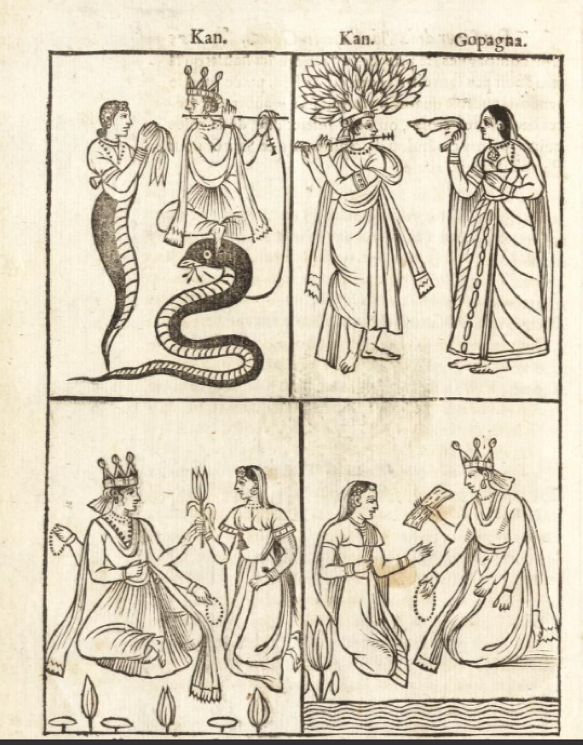
An illustrated manuscript of the Travels of La Boullaye has been found in the library of the Accademia dei Lincei in Rome. There are differences in content as well as the illustrations between this manuscript and the 1653 printed edition. For example, La Boullaye’s European travels are omitted from the manuscript which mainly depicts the second voyage of the author. Sanjay Subrahmanyam suggests that these were painted by an Indian artist practising Mughal miniatures and probably only a schematic crude version reached the publisher in Paris. If that is true that would explain some Persianate features of the illustrations. Michele Bernardini describes the differences in detail in her essay and suggests that since this manuscript was presented by the author to Cardinal Capponi and remained in Rome, it is likely that another manuscript was taken by the author to Paris which was the source of the printed manuscript. La Boullaye had come as an Ambassador from Louis XIV to Aurangzeb’s court and it was the policy of Colbert to send various ambassadors and French travellers to India to gather information about the Mughal court and assess what trade possibilities might be taken advantage of. Travellers like Thévenot and La Boullaye however, richly added to their commercial endeavours by simultaneously drawing illustrations and imaginatively recording the customs and features of the people and the flora and fauna of India.
Further Reading:
- Bernardini, Michele. ‘Illustrations of a Manuscript of the Travel Account of François de la Boullaye le Gouz in the Library of the Accademia Nazionale dei Lincei in Rome’. Muqarnas, Vol. 21, Essays in Honor of J. M. Rogers (2004), pp. 55-72. Stable URL: http://www.jstor.org/stable/1523344.
- Curto, Diogo Ramada. “Reports of Voyages to Goa and the State of India”; Chapter in Imperial Culture and Colonial Projects: The Portuguese-Speaking World from the Fifteenth to the Eighteenth Centuries. Berghahn Books. (2020) Stable URL: https://www.jstor.org/stable/j.ctv21hrg04.16.
- Kirli, Cengiz. ‘Coffeehouses leisure and sociability in Ottoman Istanbul’ in Peter Borsay and Jan Hein Furnée, eds., Leisure cultures in urban Europe, c.1700–1870: A transnational perspective. Manchester University Press, 2015. Stable URL: https://www.jstor.org/stable/j.ctt18j8zcq.14.
- Kundra, S, Sinha, A and Sarwal, A. ‘French Encounters of François De La Boullaye Le Gouz in India: Hindu Mythological Illustrations and Narratives.’ Ancient Asia, 13: 7, (2022), pp. 1–16. DOI: https://doi. org/10.5334/aa.269.
- La-Boullaye Le-Gouz, Sieur de. Les Voyages et Observations de Sieur de La-Boullaye-Le Gouz Gentil-homme Angevin (Paris : 1653). https://archive.org/details/gri_voyagesetobs00lego/page/186/mode/2up.
- Pourjavady, Amir Hosein. ‘Courtesans and Concubines in Early Modern Iran’. Chapter in Music Making in Iran from the 15th to the Early 20th Century. Edinburgh University Press, 2023. Stable URL: https://www.jstor.org/stable/10.3366/jj.9941199.9.
- Sen, Surendranath. Ed. Indian Travels of Thevenot and Careri: Being the Third Part of the Travels of M. de Thevenot into the Levant and the Third Part of a Voyage Round the World by Dr. John Francis Gemelli Careri. New Delhi: National Archives of India, 1949. Reprt. New Delhi: Gyan Publishing House, 2020 (2nd Impression).
- Subrahmanyam, Sanjay. ‘Once bitten, twice shy: A French traveller and go-between in Mughal India, 1648–67’. The Indian Economic and Social History Review, 58, 2 (2021): 153–212. SAGE, Los Angeles/London/New Delhi/Singapore/Washington DC/Melbourne DOI: 10.1177/0019464621997863.
- Thévenot, Jean de. The Travels of Monsieur de Thevenot. In Three Parts. VIZ. Into I. Turkey II. Persia III. The East-Indies. Newly done out of French [1687] [Translated by A. Lovell] of which Part III has the title: The Travels of Monsieur de Thevenot, The Third Part: Containing the Relation of Indostan, the New Moguls and of other Peoples and Countries of the INDIES now made English (London:1687). https://archive.org/details/travelsofmonsieu00thev/page/n7/mode/2up.
- Thompson, Jason. ‘Ancient Egypt in the Renaissance Book’. Chapter in Wonderful Things: A History of Egyptology: 1: From Antiquity to 1881. The American University in Cairo Press. (2015) Stable URL: https://www.jstor.org/stable/j.ctv2ks71bp.9.
Image Credits:
Wikimedia Commons. Retrieved 28 September, 2026.
Featured images: https://commons.wikimedia.org/wiki/File:Philippe_de_Champaigne,_Portrait_of_Jean_de_Th%C3%A9venot,_ca.1660._Oil_on_canvas,_59.7_x_43.2_cm,_The_Huntington_Library,_inv._2010.2.jpg and https://commons.wikimedia.org/wiki/File:Houghton_Typ_615.57.508_-_Fran%C3%A7ois_Le_Gouz_de_La_Boullaye,_1657.jpg.
Banner created on Canva by Debapriya Basu.
- All translations by the author of this post. ↩︎