
Debapriya Basu
“Then they did put me on the rack, because I confessed no ladies nor gentlewomen to be of my opinion, and thereon they kept me a long time. And because I lay still and did not cry, my lord Chancellor and master Rich, took pains to rack me their own hands till I was nigh dead.”
(The Latter Examination of Anne Askew, 1547, Beilin 127)
Flagging off the SEMS Text of the Month (ToteM) series this May are two books with hearts that beat as one: The First Examination of Anne Askew (1546) and The Latter Examination of Anne Askew (1547). They were published under a false imprint because they contained politically sensitive material and record the events that led to the burning of the 26-year-old Protestant martyr Anne Askew at the stake for heresy. Narrated in her own laconic voice, with continuous commentary by the indefatigable John Bale, the books reveal the fierce struggle over who could read, interpret, and preach Scripture that was taking place at the time.
Written in prison, and smuggled out to co-religionists in exile, the texts treat the Bible as both guide and weapon. Askew appeals repeatedly to specific passages, revealing her remarkable scholarship; parries her examiners’ questions with biblical citation; and insists that faith must be grounded in personal understanding of Scripture rather than in the authority of priests or councils. In doing so, this compound text positions the vernacular Bible as the highest authority, one that can be used by laypeople, including women, to defend their private faith, argue theology or even challenge clerical power.
The text also highlights the legal and religious machinery that inflicts illegal torture and death on Askew. Recently-ratified laws such as the Six Articles (1539) and the Act for the Advancement of True Religion (1543) haunt the dialogue between Anne and her interrogators. They provide the framework for her prosecution and show how doctrinal questions about the Eucharist were turned into criminal charges. The examinations themselves display a kind of legal theatre: formal questions, repeated probing, and attempts to trap her into implicating others, especially other women, and particularly King Henry VIII’s last wife, Catherine Parr. Within these physical and figurative constraints, Askew’s voice manages to resist her interrogators through irony, open insult, strategic silence, and a persistent return to the Bible as her ultimate authority:
Secondly he said that there was a woman, which did testify, that I should read, how god was not in temples made with hands. Then I showed him the; vii. and the .xvii. Cha[pter] of the acts of the Apostles, what Steven and Paul had said therein. Whereupon he asked me, how I took those sentences? I answered that I would not throw pearls among swine, for acorns were good enough.
(The First Examination, 1546, Beilin, 166)
But we must not forget “bilious Bale,” whose strident presence in the text shapes what could have been just another spiritual autobiography into a contemporary bestseller, and leaves us with a textual diptych that is as compelling in its form as it is in content. Through copious glosses, Bale performs his own interrogation of Askew’s testimony, interrupting her brief, tightly-argued responses with high polemic that at times threatens to drown her tone and later shapes her reception as “a gentlewoman very young, dainty and tender” (The First Examination, Beilin, 7). But this is also the curiosity that turns the text into a complex and layered object, richly rewarding to read. Askew’s own words form a core of sharp, controlled argument, while later male voices (such as John Foxe’s in the highly popular Book of Martyrs, 1563) add narrative drama, pictorial representation, martyr‑halos, and polemic against Rome. In its afterlife, the text is both a record of Askew’s resistance and a tool for Protestant propaganda, smoothed and sharpened to fit a particular sectarian purpose.
This compound text preserves for us what the spectacle of Anne Askew’s burning perhaps cannot fully capture: a fascinating duet of two minds radically different in quality but united in resolve. Baffling gender expectations, Askew’s cool, quick, and self-aware voice resists not only her captors’ violence, but also her male editor and champion’s emotional outpourings. Later martyrological images may emphasise pathos and spectacle, but the work itself privileges clarity, memory, and the power of a single, carefully chosen piece of text to counter, even if momentarily, the unbearable cruelties of state-sanctioned violence.
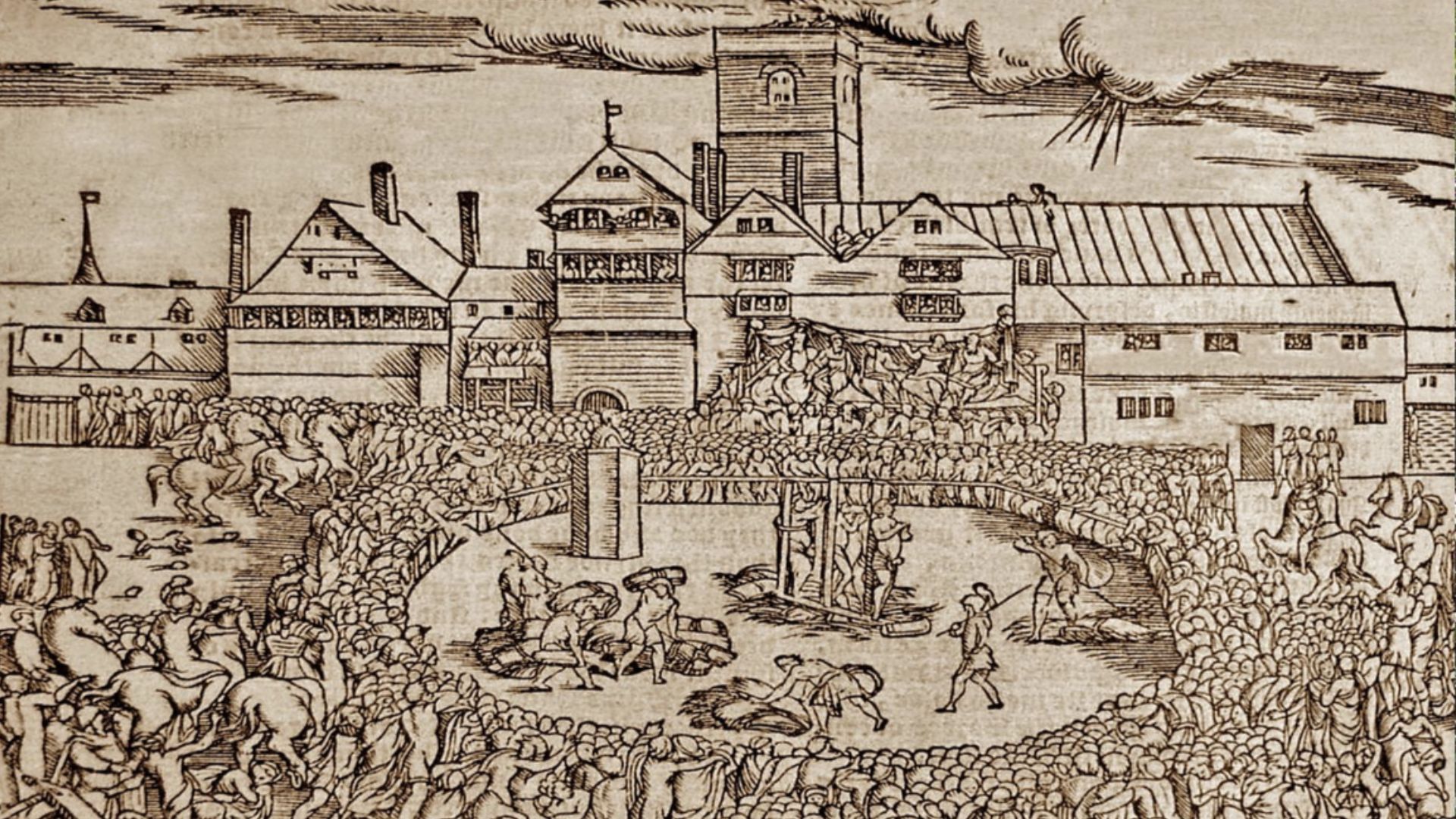
The featured image is the famous woodcut of the burning of Anne Askew at Smithfield in 1546 in John Foxe’s Acts and Monuments, reproduced from Robert Crowley’s 1548 pamphlet The confutation of .xiii. articles, printed by or for Foxe’s printer, John Day. Nicholas Shaxton, Bishop of Salisbury, who had recanted and preached at Askew’s burning, is shown at the makeshift pulpit near the stake. The illustration closely follows John Bale’s description in the Examinations, including the thunderbolt in the clouds (image source: The Unabridged Acts and Monuments Online)
Read more:
- Askew, Anne. The Examinations of Anne Askew. Edited by Elaine V. Beilin. Oxford University Press, 1996. https://doi.org/10.1093/oso/9780195108484.001.0001. Spelling has been modernised for the text quoted from this edition, but original punctuation has been retained.
- Askew, Anne. The Examinations of Anne Askew: An Electronic Edition. Edited by Debapriya Basu. University of Amsterdam, 2015. https://anne-askew.humanities.uva.nl/index.htm.
- Hickerson, Megan. ‘Negotiating Heresy in Tudor England: Anne Askew and the Bishop of London’. The Journal of British Studies 46, no. 4 (2007): 774–95. https://doi.org/10.1086/520259.
- Pender, Patricia. “Sola Scriptura: Reading, Speech, and Silence in The Examinations of Anne Askew.” In Early Modern Women’s Writing and the Rhetoric of Modesty, edited by Patricia Pender, 36–63. Early Modern Literature in History. Palgrave Macmillan UK, 2012.. https://doi.org/10.1057/9781137008015_3.
- Basu, Debapriya. ‘Anne Askew: Re-Forming a Dangerous Woman’. Dangerous Women Project, 16 September 2016. IASH, University of Edinburgh. https://dangerouswomenproject.org/2016/09/16/anne-askew-2/.
[…] Our first ToteM is the diptych work, The Examinations of Anne Askew, introduced by Debapriya Basu. Read about it here. […]