
John Donne’s Biathanatos
Doyeeta Majumdar
“nothing that we call sin is so against nature, but that it may be sometimes agreeable to nature”
Biathanatos, I.i.7
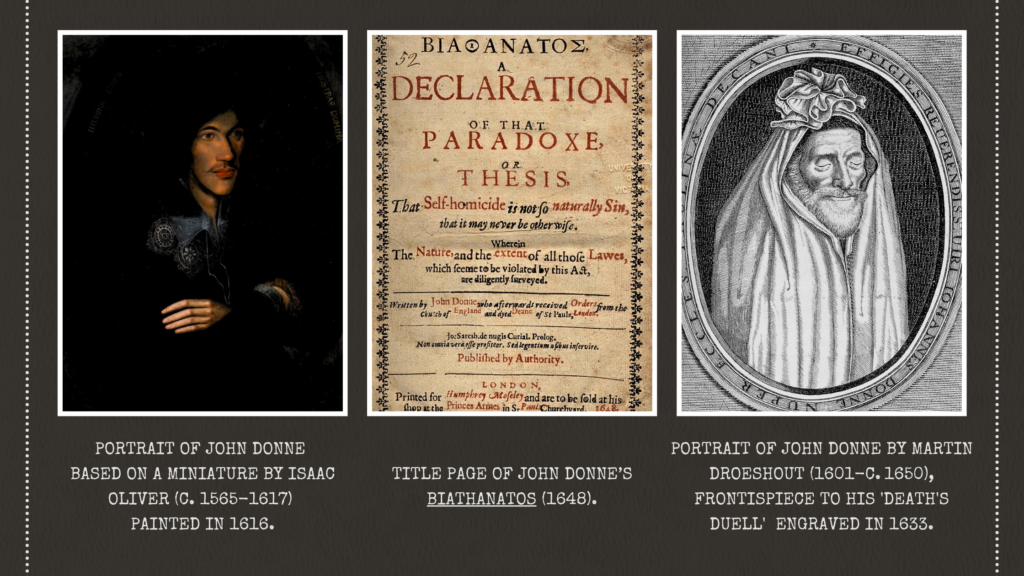
When Hamlet muses upon “a consummation devoutly to be wished” (III.i), suicide was considered a felo de se—a crime against oneself. In England and elsewhere in Christendom, suicides were denied a church burial, their corpses were buried at crossroads with stakes driven through their hearts, their property was forfeited to the Crown. It was in such a world that John Donne wrote Biathanatos (Greek for ‘violent death’)— a treatise in defence of suicides. Donne’s poetry—particularly his erotic poetry—continues to be a fixture in the canon and is the scaffolding of his reputation. His prose, however, the sermons, meditations, paradoxes, and other longer treatises, are almost exclusively the domain of specialist research scholars. Within this corpus shadowed by obscurity, Biathanatos occupies a particularly inaccessible niche, due as much to its polemical subject matter as to its perversely recondite prose style.
Written between 1607 and 1609, it was only published once in the seventeenth century, in 1648, posthumously. Donne himself suppressed the text and apparently instructed his son to safeguard it from “both the press and the fire” (Dedicatory letter of Philip Herbert, Earl of Pembroke, 1648 edition, unpaginated, Garland edition p. 5.) A manuscript was sent to Sir Edward Herbert, later Baron of Cherbury, another to a friend Sir Robert Ker with a letter in which the author displays his full awareness of the dangers implicit in a work so utterly “misinterpretable” (Garland edition, p. 4). It could be construed as an exhortation to commit one of the worst sins in Christianity, because suicide was associated not with mental illness primarily, but with spiritual ‘despair’, a state of the soul which implied a fundamental lack of faith in the omnipotence of God.
In the Preface, Donne acknowledges his own life-long struggles with this “sickly inclination,” which was fed by his “first breeding” at the hands of martyrdom-obsessed Jesuits. Born a Catholic in Protestant England, a young John Donne grew up witnessing the barbaric execution of his people, his relatives and peers. Though his later life is marked by his apostasy and often virulent attacks on his erstwhile faith, the preoccupation with martyrdom and “self-homicide” continued to haunt him.
Suicide was at once crime against one’s own self, the state, and the Church. To address this triple-layered crime, the text is arranged into a tripartite structure—each section taking on the Law of Nature, the Law of Reason (also including positive law, i.e., the law of the state) and the Law of God. Through complicated casuistry—that is, the examination of particular cases against general principles of law, morality, and conscience—he goes on to establish that far from being unnatural, the impulse towards self-annihilation is entirely human and thus natural. His definition of suicide in Biathanatos is broad enough to include examples ranging from Jesuit martyrdom to widow-burning in “the kingdom of Bengala in the Indies” (I.ii.3–a surprise, that one!), with countless other historical and civilizational examples in between, in a bid to normalize both the act and the impulse.
Moreover, he says, God would not allow the existence of “impenitible” acts (Donne coins this adjective, it means the impossibility of penitence). Later, in his characteristically paradoxical way, he asserts “nothing that we call sin is so against nature, but that it maybe sometimes agreeable to nature” (I.i.7).
Second, even when there is explicit legislation against suicide, exceptions are always made on a case to case basis. Exceptions, in general, characterize all juridical structures anyway, why should suicide laws be any different? The second part also features the radical argument that if suicide is a sin because it violates the commandment against killing, then so is capital punishment. “[T]he state cannot take away our life, for that is no more lord of our life than we are” (II.v.1) is perhaps one of the earliest known indictments of capital punishment, even if it is for the sake of argument.
Running through the treatise is the paradox that, given that martyrdom was the fulcrum of early Christianity, Christianity’s subsequent severe injunctions against suicide seem bewildering. In the third book this is bolstered by the argument that there is nothing in the Bible that explicitly condemns suicides to eternal damnation, nor can the fifth commandment “Thou shalt not kill” be construed to single out self-homicide from all other kinds. In any case “there is no external act naturally evil; and that circumstances condition them and give them their nature” (III.iii.3). Donne’s final tour de force is something that text was perhaps always gesturing towards: collapsing the distinction between martyrdom and suicide, he argues that suicides carried out to uphold the glory of God is not just condoned in Christianity but actively encouraged. The treatise culminates in the explosively blasphemous assertion that Christ himself was a suicide. Sure, he was brutalized by the Romans, but crucified men stay alive for much longer than Christ did, and the “actual emission of his soul, which is death, and which was his own act, and before his natural time” (III.iv.5). Never a man to pass up an opportunity to provoke and aggravate, he immediately follows this profane assertion with a reference to Judas’s suicide. Jesus and Judas, at two poles of the drama of crucifixion, are both suicides—the central event of the Christian faith is bookended by suicides. Donne pleads for leniency for even Judas.
Ultimately Donne keeps narrowing the limits of permissible suicides till we are left with only the glory of God as a justifiable cause. Christ’s suicide thus becomes the exemplar of good suicides for all time—an act of perfect charity. Self-serving suicides are not condoned; these include suicide for personal glory, to escape trouble or misery. Centuries later, Thomas de Quincey writes that Donne makes an essential distinction between self-homicide and self-murder (“On Suicide” 1827, p. 209), the former could not even be considered as suicide proper.
It is also significant, as Michael Rudick and M. Pabst Battin point out in their Introduction to the 1982 edition, that Donne deliberately eschews pro-suicide arguments drawn from Classical Antiquity. The Stoics, particularly Seneca (who famously said “You ask, what is the path to freedom? Any vein in your body,” De Ira, 15) is conspicuous by his absence. Donne knows his primary opponents are Christian theologians and he answers them with examples drawn almost exclusively from Christian casuistry, choosing for himself the “maximal task” (Introduction xxiv)—entirely of a piece with Donne’s intellectual vanity.
He calls his opponents scholastic and “artificial men” (Preface) and what offends him most is their smug assumption of superiority vis-à-vis the figure of the suicide. Continuously wracked by self-doubt and anxieties all his life, for Donne, certainty and smugness indicated stasis and the demise of the intellect.
Despite its polemical nature, it is also a deeply private text. I read it as a personal, therapeutic exercise, which helps him overcome his own “sickly inclination.” Donne’s twinned obsession with sex and death would make him a fascinating case study for Freudian psychoanalysis. As John Carey says, the extent to which death intrudes upon his love poems “would have been debilitating” for a lesser poet (p. 209). He delivered his most famous sermon Death’s Duell clad in shroud, to drive home the startling conceit in which he compares the womb to a foetal shroud. Death, like love and faith, is always a challenge for Donne, a call to arms. In his belligerent sonnet “Death be not proud” he throws down the gauntlet in no uncertain terms. In an undated letter to Sir Henry Goodyer he writes:
I would not that death should take me asleep. I would not have him merely seize me, and only declare me to be dead, but win me, and overcome me. When I must shipwreck, I would do it in a sea, where mine impotency might have some excuse; not in a sullen weedy lake, where I could not have so much as exercise for my swimming. (Gosse edition, vol. 1, p. 191)
Suicide is the most active form of death (Carey, p. 204). If passivity is metaphorical death, it is in the act of self-slaughter that man is truly alive, and it is in Christ’s self-slaughter that we find the meaning of the universe. I conclude with this passage from Borges, which, by extending the argument of this curious, difficult, quasi-blasphemous text, also uncovers momentous interpretive possibilities:
Christ died a voluntary death, Donne suggests, and this means that the elements and the terrestrial orb and the generations of mankind and Egypt and Rome and Babylon and Judah were extracted from nothingness in order to destroy him. Perhaps iron was created for the nails, and thorns for the mock crown, and blood and water for the wound. This baroque idea glimmers behind Biathanatos. The idea of a god who creates the universe in order to create his own gallows. (p. 335)
Image credits (left to right):
Miniature: Wikimedia Commons
Biathanatos title page image: University of Victoria library exhibit
Portrait in shroud: Wikimedia Commons
Read more:
I’ve used the following edition:
Biathanatos, Edited by Michael Rudick and M. Pabst Battin, Garland Publishing, 1982.
Other works:
Thomas De Quincey, “On Suicide,” in Essays in Philosophy. Boston and New York: Houghton, Mifflin and Co., 1856, pp. 209–213.
Jorge Luis Borges, Selected Non-Fictions. Ed. Eliot Weinberger. Trans. Esther Allen, Suzanne Jill Levine, and Eliot Weinberger. New York: Viking, 1999.
John Carey, John Donne, Life, Mind, and Art. Oxford University Press, 1981.
Edmund Gosse, The Life and Letters of John Donne, Dean of St. Paul’s. 2 vols. New York: Dodd, Mead and Co., 1899.